 Русский
 English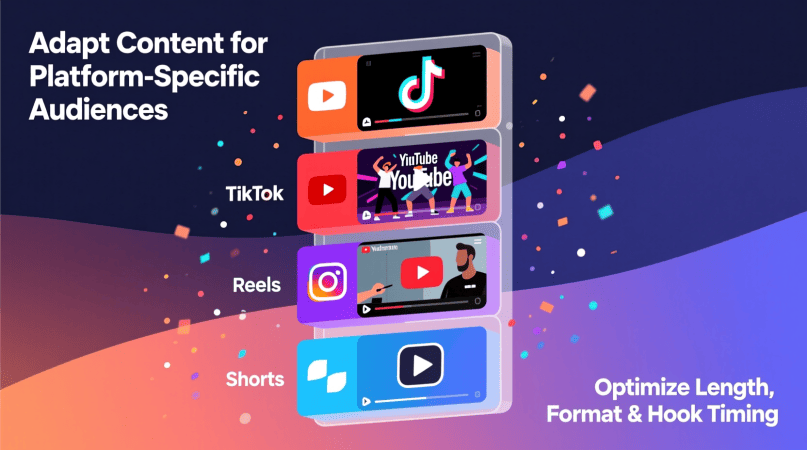
Simply copying your YouTube video or Short across all social platforms is a direct path to diminished engagement metrics. TikTok audiences consume content fundamentally differently than Instagram users. These platform algorithms operate on distinct ranking principles. Uniform content distribution typically generates minimal response—audiences simply scroll past it.
Effective cross-posting requires platform-specific adaptation. This extends beyond simple video cropping. You need to understand what captures viewer attention on each specific platform, then modify format, audio, text overlays, and calls-to-action to align with those expectations. This article will demonstrate how to transform your YouTube videos and Shorts for alternative platforms.
Source Material Preparation
Effective adaptation begins with selecting the right YouTube content and organizing your production resources. Not every video translates equally well for cross-platform repurposing.
Prioritize videos that have already demonstrated performance: high reach or engagement metrics. Ideal candidates include videos with clear structural elements—lists, step-by-step tutorials, Q&A segments, or visual demonstrations. These formats segment more efficiently into shorter content blocks.
Visual composition matters significantly: dynamic footage, integrated graphics, screencasts, or active demonstrations perform better in short-form formats than static imagery. Consider topic universality—the subject should resonate with audiences beyond YouTube, extending to other platforms where you plan to distribute.
Systematic Source Material Organization
Systematizing source materials dramatically accelerates the adaptation process. Create centralized storage for rapid access to all necessary assets:
Video Files: Always preserve original long-form content (master files) and YouTube Shorts at maximum quality resolution.
Scripts and Text Elements: Include complete scripts or detailed outlines from long-form videos, text used in Shorts, plus valuable excerpts, quotations, or data points that can be extracted independently.

Visual Assets: Store video thumbnails in high resolution, individual graphic elements, background images or video clips.
Audio Components: Maintain clean voice tracks if exported separately, background music files, and sound effects.
Transcription Materials: Keep ready-to-use subtitle files and complete video transcripts readily accessible. This is critical for locating specific phrases and rapidly generating on-screen text.
This organized repository transforms searching for specific clips, graphics, or audio from a chaotic process into a streamlined operation, conserving time at every stage of content adaptation.
Platform-Specific Content Adaptation
Simply reuploading videos across different platforms doesn't generate results. Each requires a distinct approach.
Transforming Long-Form YouTube Videos into Shorts, Reels, or TikTok:
Extract the core message. Identify the most compelling 30-60 second segment that delivers standalone value.
Reformat comprehensively—mandatory vertical orientation (9:16). Don't simply crop edges—recompose the frame so primary elements are centered. Increase pacing, implement rapid transitions, accelerate unnecessary pauses.
Add on-screen text overlays. Highlight key points, create visual emphasis for crucial information.
Utilize current trending audio from platform-native libraries.
Leverage platform-specific features. Incorporate interactive stickers, trending effects, native tools.
Rewrite descriptions from scratch. Create text and hashtags specifically optimized for each platform's algorithm and audience expectations.
Adapting YouTube Shorts for Reels and TikTok:
Replace audio tracks. Third-party music from YouTube may be unavailable or violate platform policies. Source audio from the target platform's library.
Redesign on-screen text elements. Modify styling, fonts, and positioning to match the visual language of Reels or TikTok.

Update calls-to-action. Specify actions relevant to the new platform context.
Add platform-native elements. Integrate current stickers, effects, and templates specific to that platform.
Don't automate adaptation. Publication can be scheduled, but modifying format, audio, text, and contextual elements requires manual execution tailored to each platform's specifications.
Technical Implementation Requirements
Technical execution quality directly impacts adapted content performance. Account for each platform's specifications.
Video Dimensions and Orientation:
Vertical video: Maintain 9:16 aspect ratio, minimum resolution 720x1280, optimal at 1080x1920. Eliminate black bars on sides.
Square video (1:1): Appropriate for LinkedIn and Facebook feeds, occasionally Instagram Feed.
Horizontal video: Classic 16:9 ratio for long-form content or material with complex graphics.
Duration Parameters:
- YouTube Shorts: Up to 60 seconds
- Instagram Reels: Up to 90 seconds, optimal 30-60 seconds
- TikTok: Up to 10 minutes, but trending content typically 15-60 seconds
Audio and Subtitle Requirements:
Verify absence of background noise, distortion, or unclear speech. Normalize audio levels across content.
Always utilize music from official platform libraries or commercially licensed sources. Audio from third-party YouTube videos frequently gets blocked on other platforms.
Over 80% of social media views occur without audio. Add synchronized captions consistently.
Deploy high-quality, informative thumbnails where platform functionality permits. Text should be large, readable at thumbnail scale.
Strategic Cross-Posting Implementation
Systematic cross-posting isn't about additional workload burden. It's about transforming your YouTube content into a multi-platform asset that generates results 24/7 while you develop new material. Begin by adapting one video following complete specifications—the results will demonstrate why continued implementation delivers compounding returns.