 Русский
 English

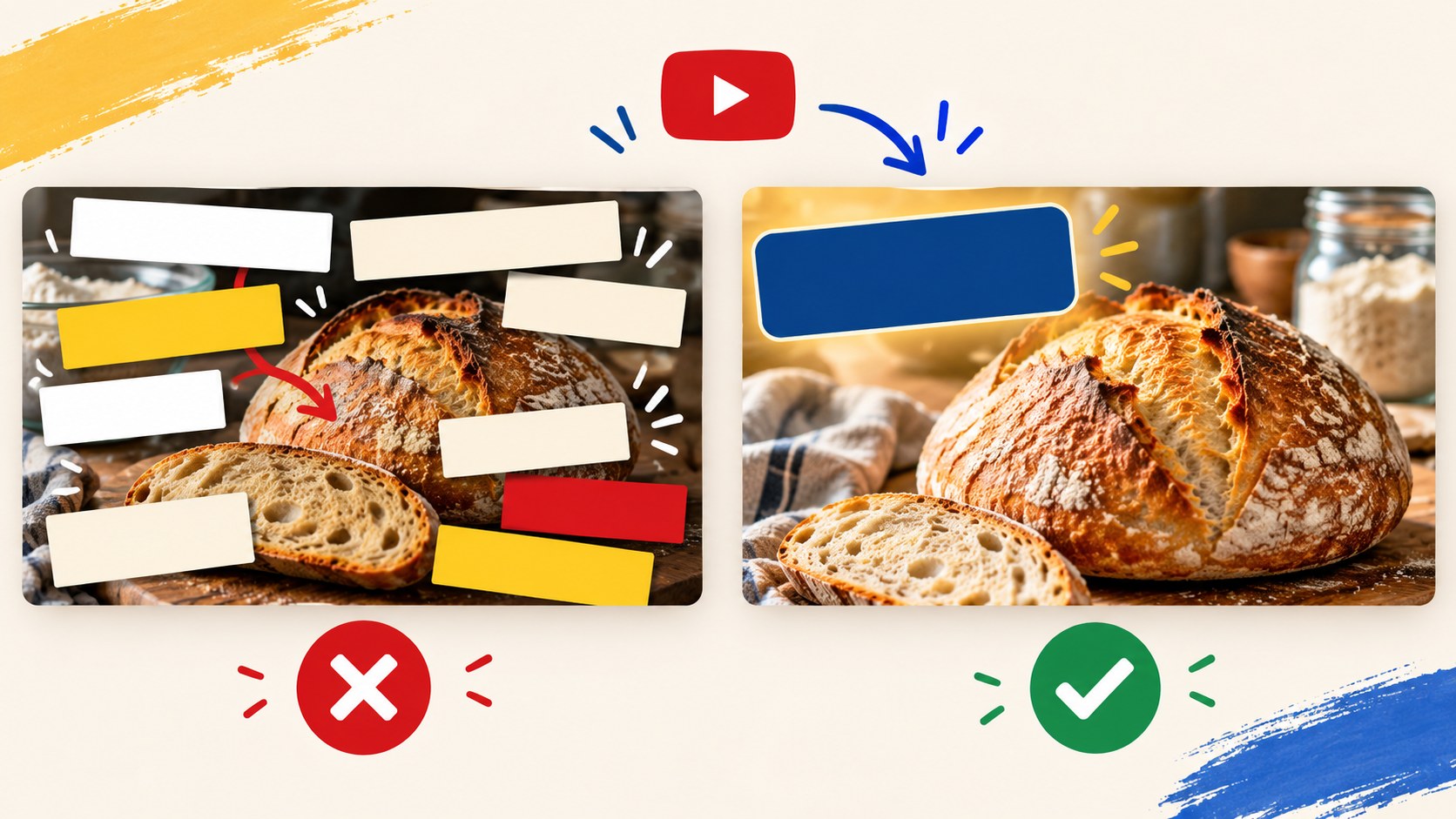
Usually, the thumbnail caption is more useful when it adds a detail rather than reproducing the title. The title can identify the subject, while the image and its lettering communicate a result, condition, verdict or question. Some overlap is helpful, especially for a product name or a recognizable problem, but repeating the whole title often wastes limited space.
Give each part of the video card a job
Imagine a pizza tutorial. The photograph shows the pizza. The title explains the method and temperature. A caption reading “PIZZA” adds very little; “NO PIZZA STONE” introduces a useful constraint the photograph cannot show.
The title can be truncated in some layouts. Thumbnail lettering has a different limitation: it shrinks with the image and can be covered by interface elements. Neither surface guarantees that every word will be read. Keep the title's opening meaningful and the thumbnail's essential text short and away from vulnerable edges.
Six things a thumbnail caption can add
These fictional examples illustrate ways to divide information. Amounts, quotations, timelines and verdicts must match the real video before you use them.
| Title | Thumbnail text | Added information |
|---|---|---|
| I learned Spanish through TV for a month | NO SUBTITLES? | A target the experiment is testing |
| Three months editing on a budget laptop | NO REGRETS | The creator's verdict |
| My first attempt at repairing a damaged wall | ONE WEEKEND | A duration |
| Better pizza in an ordinary oven | NO STONE | A useful condition |
| A former recruiter explains the interview process | “SHOW THE WORK” | A real quotation, if the speaker actually says it |
| What moving to a smaller city cost us | CHEAPER OVERALL? | A comparison the viewer can relate to |
A verdict can reveal the answer while leaving the explanation worth watching. “NO REGRETS” works only when that is genuinely the conclusion. A question can preserve uncertainty, but it should be a question the video answers rather than one invented to attract attention.
A quotation deserves particular care. Do not turn a hypothetical line from a writing exercise into an attributed statement. Shorten a real quote without changing its meaning, and retain enough context to avoid reversing the speaker's position.
Useful roles for short thumbnail copy
- A result or verdict: “IT WORKS,” “I RETURNED IT,” or a concrete outcome.
- A number or duration that matters to the story.
- A limitation: no special equipment, no prior experience or an ordinary location.
- A brief, accurate quotation from the interview.
- The unresolved goal of an experiment.
- A comparison with a familiar alternative.
The image should still contribute something of its own. If a product is plainly visible, the text may be better used to state what is unusual about this review. If the picture is abstract, a literal label may be needed before any clever wording becomes useful.
When repeating words makes sense
A search-led tutorial may benefit from repeating a recognizable problem in the image. Someone scanning results for a condensation problem can quickly identify “WET WINDOWS.” A guest's name or device model may also deserve to appear both in the title and image.
Repeat the part that helps orientation, then use remaining space for new information. The rule is not “never repeat.” It is “make every repeated word justify its space.” A shorter version of the title can be the clearest choice for an unfamiliar technical subject.
A process for writing text after the title is fixed
- Read the title and identify what it already explains.
- List concrete details from the video: a time limit, result, obstacle, unusual condition or genuine quotation.
- Choose one detail that changes the viewer's understanding of the offer.
- Draft a short caption and compare it with a plain, literal alternative.
- Check whether it duplicates the visible object as well as the title.
- Show the image and title together to someone who has not watched the video.
Ask that person what they expect to see and learn. You are checking the promise, not asking them to predict click-through rate from taste.
A worked example: a driving-test story
Take the fictional title “I passed my driving test first time: how I prepared.” Several captions are possible:
- “FIRST TIME” repeats the result.
- “DRIVING TEST” confirms the topic but adds little if the image already makes it obvious.
- “TWO WEEKS OF PRACTICE” adds a timeline, if that timeline is accurate.
- “LESSONS WEREN'T ENOUGH” introduces an obstacle, if the video explains it honestly.
The final two versions ask different questions. One focuses on preparation time; the other on what was missing. They can be tested as alternative packages for an eligible video. Do not use either merely because it sounds stronger than the real experience.
When no caption is the better option
A clear transformation, a striking location or an expressive scene may not need additional lettering. Let the title carry the verbal explanation and compare the clean image with a captioned version at small size.
Removing text is not automatically an improvement. If the scene loses its context or could imply the wrong subject, keep a useful label or improve the title. The goal is clarity, not minimalism for its own sake.
Build the pair in Bloggers.tools
You can specify your own wording in Bloggers.tools thumbnail generation in both Automatic and Professional modes. If you let the service suggest the text, check it against the chosen title and the actual content. A generated caption should be treated as a draft to review.
Video SEO can help produce title options. Select the title and thumbnail together, then download and upload the image manually. If comparing captions, keep the main concept stable enough to make the comparison useful.
Frequently asked questions
Can I put a shorter title on the thumbnail?
Yes, particularly when it helps identify an unfamiliar subject. Also try a complementary detail and compare the complete cards. Repetition is a trade-off, not an automatic failure.
What if the video is designed for search?
Make the task or problem easy to recognize. Repeating one key term can help; copying a long search phrase into the image usually forces smaller lettering.
Should thumbnail text use the same language as the title?
Usually it should match the intended viewer's language. A familiar product name or term may be an exception. For multilingual audiences, a clear image without text can remove one language barrier.
How do I know the pair makes sense?
An unfamiliar viewer should identify the topic and a specific reason to watch without forming an expectation the video cannot meet.
Platform reference: YouTube's title and thumbnail guidance.