 Русский
 English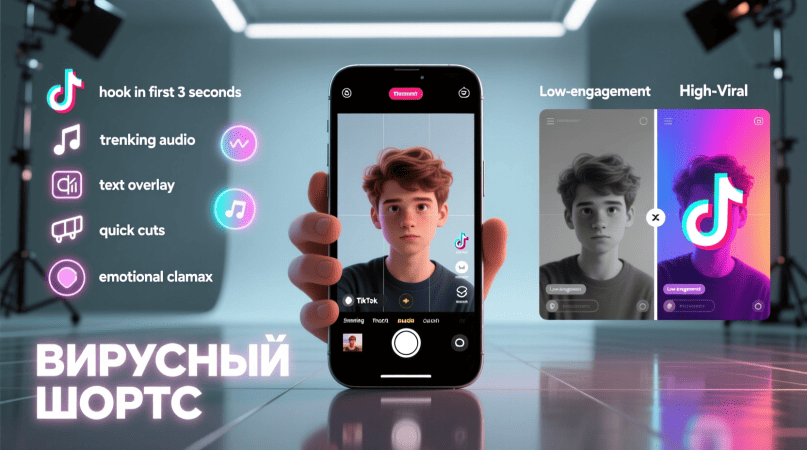
Short-form video formats like Shorts, Reels, and TikTok are now the primary method for capturing audience attention. Platform algorithms prioritize content that hooks viewers in the first few seconds and drives watch-through to completion. Without this, your content simply gets lost in the feed. Let's break down how to create Shorts that generate millions of views.
How Algorithms and Viewer Attention Determine Shorts Success
Viral videos aren't accidents. They're the result of precise execution across two critical forces:
- Platform mechanics
- Human attention psychology
Ignore either, and your Shorts disappear into the feed.
Algorithm Mechanics – What Platforms Promote
Algorithms promote content based on 4 criteria. To create viral Shorts, you must optimize for:
Initial Retention Rate. Percentage of viewers who watch past the first 3 seconds. Below 65% = failure. The algorithm immediately reduces distribution.
Complete View Rate. Videos with 70%+ completion rates get pushed to mass audiences. Full watch-through is the strongest quality signal.
Engagement. Likes, comments, shares. Without viewer actions, growth stops.
CTR (Click-Through Rate). Compelling openings that make users click from the feed. Without this, you won't reach your initial audience.
The algorithm tests Shorts on 2-5% of your subscribers first. Poor performance on these metrics blocks recommendation distribution.
Attention Psychology – How to Retain Viewers
The first moments determine a video's fate. Viewer brains scan content for threat or value:
- Deploy visual shock – before/after contrasts, unexpected actions like breaking objects
- Create intrigue through open questions: "Why did I throw away my laptop?"
- Promise concrete value: "Eliminate back pain in 60 seconds"
- Identify audience pain points: "The copywriting mistake killing your conversion"
Without a powerful hook, viewers leave before the algorithm can evaluate your content.
After capturing attention, engage evaluation mode. Maintain viewer interest by changing visual patterns every 1-2 seconds – shift from close-ups to wide shots, add detail layers. Duplicate key points with on-screen text: 50% of audiences watch without sound, especially in public spaces. Control editing rhythm: alternate rapid cuts for dynamics with micro-pauses to emphasize important moments. Monotony is retention's greatest enemy.
Leverage deep motivators. Curiosity works through incomplete actions: "How did I build this mechanism?". Value must be tangible: "This hack saves 3 hours per week". Emotions cement information in memory and trigger engagement – the primary fuel for algorithms.
Finding Viral Ideas: Where to Look and How to Analyze
Successful Shorts begin with trending ideas. Use three research sources.
Trend Analysis Through Platform Tools
Platforms provide free research tools. In TikTok Creative Center, study the "Trending Videos" section: filter by niche, duration, and geography. Focus on videos showing 500%+ view growth within a week.
On YouTube, navigate to "Trends" and "Shorts". Analyze videos with sudden view spikes. Key markers: high distribution velocity and engagement rates.
Competitor and Influencer Monitoring
Identify accounts generating 500K+ views per video in your niche. Analyze:
- Shorts publishing frequency among top creators
- Percentage of videos with 60%+ watch-through
- Topics generating maximum reach
Pay special attention to 5 elements:
- Hook format – visual/text
- Active action length
- Editing patterns
- CTA type – comments, subscriptions, or links
- Trend seasonality
Take the working structure but modify the content.

Using Comments as Idea Sources
Comment sections under viral Shorts are databases of ready-made queries. Look for:
- Questions
- Pain points
- Continuation requests
For example, spot a top comment under "Flat Stomach Exercise" saying: "Why does my back hurt when I do this?". There's your next Short topic: "How to do planks without back pain"
Creating Explosive Scripts
Strong scripts transform ordinary videos into viral content. Execute across three core directions.
The Ideal Shorts Formula
In the first 0.5-3 seconds, deploy your hook. Create irreversible interest. Cut opening frames to sounds like impacts, claps, shattering glass. Example for cooking Shorts: knife sharply chops vegetables in slow-mo with text: "The mistake making your salad bitter".
Deliver the solution immediately. Show action, don't explain. In the same example: hand removes white veins from leaves, close-up of clean vegetables, text: "Remove this part – bitterness disappears".
Close with a clear viewer directive. For lifestyle niches: "Try this? Drop a ❤️", for business: "Download checklist in profile". Avoid generic phrases like "Subscribe".
Proven Script Patterns
Validated script structures accelerate viral content creation. These templates work because they align with algorithmic requirements and perception psychology. Use them as foundations, adapting to your niche.
Pattern 1 – Before/After. Demonstrate transformation in 8 seconds:
- Frame 1 (3 sec). Problem in close-up, like grease stain on shirt or cluttered desk
- Frame 2 (1 sec). Sharp cut with snap sound or equivalent
- Frame 3 (4 sec). Result, like clean fabric or organized space
- Follow with brief instructions on achieving the result
Pattern 2 – Mistake and Solution. Show action contrast:
- Frame 1 (4 sec). Incorrect execution, example – crooked hair coloring
- Frame 2 (0.5 sec). Freeze frame with red X and error sound
- Frame 3 (5 sec). Correct method – highlighting technique
- Text – "This is how professionals do it"
Pattern 3 – Mystery and Revelation. Create cognitive dissonance:
- Frame 1 (3 sec). Non-obvious action, like pouring cola on rusty bolt
- Frame 2 (3 sec). Time-lapse process
- Frame 3 (4 sec). Result – clean metal and text: "Cola dissolves rust in 5 minutes"
These patterns aren't dogma – they're starting points. Test them, measuring retention at the 3-second mark. Keep successful solutions, replace weak elements. The key is preserving the essence: visual contrast and instant comprehension.
Visual Storytelling
Brains process images faster than text. Your task: convey meaning through action, not explanations. Each frame must work autonomously: viewers with sound off should understand the essence. 3 rules achieve this:
Action instead of descriptions. Don't write text saying "Bend knee at 90°". Show video of back pressed to wall, slow descent into squat, arrow indicator pointing to knee angle.
Close-ups are the foundation of visual communication in Shorts. Fill the frame 80% with object or action: hands working with tools should occupy the entire screen, text – maximum 7 words at 60 pt. Avoid wide shots; viewers need to see action details, not backgrounds. For text explanations, use contrasting fonts like Arial Bold on minimalist backgrounds.
Numbers come alive through motion. Transform static information into visual action: animate amount growth from $100 to $500 over 3 seconds with moving graphs, create slider comparisons for before-after with smooth transitions, use counter effects for percentage changes. In finance Shorts, show capital increase not through numbers but expanding bar charts.
If viewers pause to examine details – you've created ideal visuals. Test videos with sound off: if meaning is clear within 5 seconds – the algorithm rewards you with retention. Primary success indicator: 25%+ increase in completion rate.

Filming and Editing
Script execution quality determines Shorts success. Technical aspects must amplify content, not distract from it.
Frame Composition Rules
Foundation of visual perception – technically flawless framing. Position light source in front of subject or at 45° angle from side – this creates depth without harsh shadows.
For stability, use tripods or gimbals, especially with camera movement. Backgrounds should be minimalist: solid walls, matte surfaces, or blur. Exception – when environment is part of the story, like demonstrating renovation in actual interiors.
Check frames before shooting: reflections, random objects in focus, shake – these errors reduce retention 15-20%.
Dynamics
Shorts rhythm requires constant visual refresh. Alternate three shot types every 1-2 seconds: close-up, medium, wide. Use digital zoom for emphasis – for example, smooth 20% magnification on key objects.
Sync text subtitle timing: word appearance synchronized with pronunciation, screen duration – 2-3 seconds. Choose sans-serif fonts with 3-5 px black outlines for readability on any background.
Audio and Editing Techniques for Retention
Audio tracks must drive retention. Start videos with sharp sound accents. Select background music by BPM: 120-130 beats for energetic content, 90-100 for educational.
Key editing technique – J-cut: next frame's audio begins 0.3 sec before visuals. This creates smooth transitions. For emphasizing important moments, use micro-pauses. Avoid layering more than 2 audio elements like voice and music or effects.
Algorithm Optimization
Technical video optimization affects ranking. Strategic metadata management increases reach 20-40%.
Concise Descriptions with Keywords and CTAs
Descriptions should fit within 2 lines, under 100 characters. Start with primary keyword: for fitness videos – "Flat stomach exercise", for business – "How to increase sales 30%".
Add numbers and specifics: "3 makeup mistakes" outperforms "Makeup tips". Close with clear CTA: "Save for workout", "Try this and comment your results".
Avoid generic phrases and emojis in first 5 words – they reduce CTR. Check descriptions in mobile view: phones only display text beginnings.
Hashtag Strategy
Use combinations of three hashtag types:
- High-frequency: 1-2 like #fitness, #business
- Low-frequency: 2-3 like #homeworkouts, #startupbusiness
- Branded: 1 – your unique tag
Validate hashtags through search: if top results show 10K+ views – tag is effective. Don't add more than 5 hashtags – appears as spam. Place them at description end or first comment.
Using Trending Sounds Without Compromising Message
Trending sounds provide +15-25% reach. Find them in "For You" sections – filter by your niche. Verify:
- Thematic alignment; don't use meme sounds in business videos
- Peak moments – synchronize key actions with track climaxes
- Volume; music shouldn't overpower voice – ratio 30% sound, 70% speech
For adaptation, trim tracks to 15-25 seconds, keeping the most recognizable fragment. If sound doesn't fit contextually – prioritize relevance.
Final Recommendations
Creating viral Shorts is a system where each stage impacts results: from trend analysis to technical optimization. The key: retain attention in opening seconds, deliver instant value, and clearly direct viewers to action. Test, analyze metrics, and adapt content to your audience.
Remember, algorithms favor consistent creators. Consistency + quality + analysis = stable reach growth. Start applying these principles today and initial results will follow quickly.